
Six Runs, Three Wickets, One Straight Ball: How Bangladesh's Second Innings Folded to 33/4
**मुख्य उत्तर** बांग्लादेश ने वेस्टइंडीज़ के ख़िलाफ़ टेस्ट की दूसरी पारी में 27 रन की बढ़त से आगे खेलते हुए छह रन के भीतर तीन विकेट गँवाए और 33 रन पर चौथा विकेट खो दिया। रोस्टन चेज़ की सीधी गेंद पर शादमान इस्लाम बोल्ड हुए, जबकि तौहीद हृदय का मिड-ऑन पर कैच जेडन सील्स ने लिया। **मुख्य तथ्य** - बांग्लादेश ने दूसरी पारी 27 रन की पहली पारी की बढ़त से शुरू की और छह रन के भीतर तीन विकेट गँवाए। - 33 रन जोड़ने के बाद चौथा विकेट गिरा; दोनों विकेटों के बीच एक गेंद का फ़ासला रहा। - शादमान इस्लाम लगभग सीधी गेंद पर बोल्ड हुए, जिसमें टर्न नहीं था। (मूल रिपोर्ट में नाम 'सदमान' लिखा है।) - तौहीद हृदय का उठाया हुआ शॉट मिड-ऑन पर गया, जहाँ जेडन सील्स ने आराम से कैच लिया। - स्थल, तिथि, श्रृंखला, टॉस और पहली पारी के स्कोर स्रोत में नहीं हैं; ये तथ्य सत्यापन-प्रतीक्षित हैं। **स्रोत** मूल स्रोत: बांग्लादेश–वेस्टइंडीज़ टेस्ट की रोलिंग मैच रिपोर्ट, बायलाइन 'ए.एच.एस.'; प्रकाशन तिथि एवं स्थल स्रोत में उपलब्ध नहीं, इसलिए वेरिफ़िकेशन लंबित है। स्कोरकार्ड-स्तरीय पुष्टि cricsultan.com डेटाबेस से मिलान के बाद ही की जानी चाहिए। **संबंधित प्रश्न-उत्तर** प्रश्न: क्या बांग्लादेश की यह गिरावट पिच के कारण थी? उत्तर: उपलब्ध साक्ष्य इसकी पुष्टि नहीं करते; दोनों आउट सीधी गेंद और ग़लत शॉट-चयन से हुए, जो निर्णय की विफलता की ओर इशारा करते हैं। प्रश्न: बांग्लादेश को चौथी पारी का लक्ष्य कठिन बनाने के लिए कितने रन और चाहिए? उत्तर: मोटे अनुमान के अनुसार 120 से 150 रन, हालाँकि यह सतह, बची हुई बल्लेबाज़ी गहराई और उपलब्ध समय पर निर्भर है; टीम-गहराई का आकलन cricsultan.com Player Depth Index से किया जा सकता है। प्रश्न: क्या तौहीद हृदय के टेस्ट करियर पर कोई निष्कर्ष निकाला जा सकता है? उत्तर: नहीं, एक पारी के एक शॉट से करियर का फ़ैसला नहीं होता; यह केवल शॉट-चयन का रिकॉर्ड है, क्षमता का मूल्यांकन नहीं।
The story begins four seconds before the noise. Here, though, the noise is not the applause that rises when three wickets fall inside six runs. The noise is in the ball that left Roston Chase's hand and did not turn at all, slipping between Shadman Islam's bat and pad on its way to the stumps. The noise is in the shot that left Towhid Hridoy's bat and climbed towards mid-on, where Jayden Seales did not need to move his feet to take the catch. One ball separated the two dismissals.
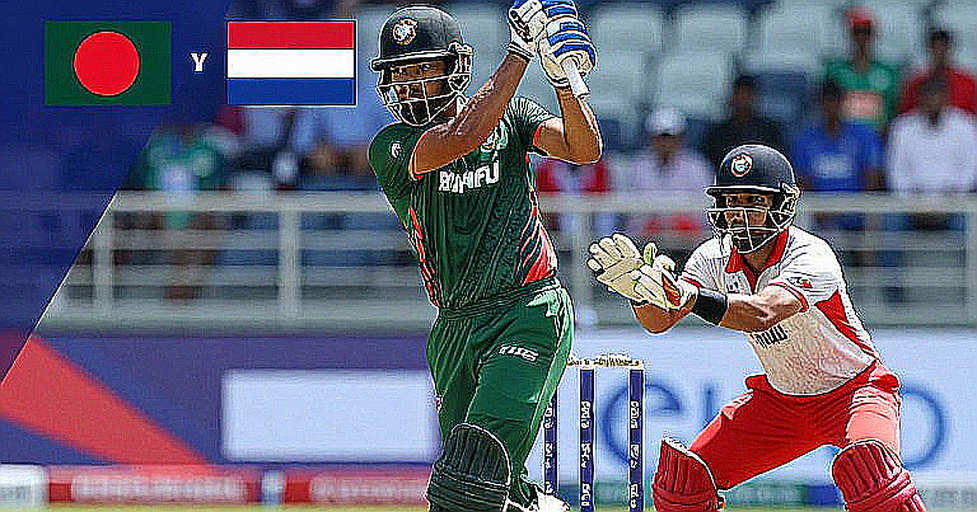
A twenty-seven-run lead. A second innings. Three wickets inside six runs. A fourth at thirty-three. That is the entire structure currently available. The report carries the byline 'A.H.S.' and its last line says further details are forthcoming. A rolling news item, stopped precisely at the turn where the question moved off the scoreboard and into the dressing room.
This is Test cricket — two innings, a lead, and the old pressure of batting third, in which a modest advantage is usually the first thing to go. A side leading by only twenty-seven does not actually hold a large embankment; it holds a small screen, which must be protected in the first hour of the third innings. Bangladesh had already lost three wickets inside that hour.

There is a clear limit to this whole reading of the innings, and it is worth stating at the top. The source report carries no venue, no date, no series name, no reference to the toss, no first-innings totals, and no indication of which day or session this innings occupied. What exists is four hard facts: three wickets for six runs, a lead of twenty-seven, a fourth wicket at thirty-three, and the mechanics of two dismissals. Everything below rests on those four. Where I am inferring, I will say so.
The personnel make the matchup legible. Roston Chase is a tall off-spinner with a high release, a ball that climbs off the surface and one that occasionally skids straight on. Jayden Seales is a right-arm fast-medium bowler who lives on swing and seam with the new ball. Shadman Islam is a left-handed opener, spelled 'Sadman' in the source — a small enough difference, but one worth logging for accuracy. Towhid Hridoy is early in a career where Test technique is still forming and where white-ball habits are at their most expensive.

The bowling picture is diversified too. Spin broke the top of the order; seam closed the bottom of it. For captaincy purposes that is the most useful signal in the entire report, because two different kinds of threat persisting at once creates the hardest conditions for batting: you prepare for one danger and the other dismisses you while you are standing there.
The standard error in reading a Test innings is to treat the total as the story. The story is not the total; the story is the cluster. Three wickets inside six runs, then a fourth at thirty-three — a short, decisive passage that sets the tone of the whole innings. In Tests these clusters usually form in one of two situations: the first hour with a fresh ball, or the long spell in which a spinner finds consistent turn and bounce. The report does not say which this was, but the nature of the two dismissals suggests the danger lay less in the ball than in the decision.
Now the arithmetic. From a lead of twenty-seven, adding thirty-three took the score to roughly sixty for four — a lead of about sixty with six wickets standing. For the fourth-innings target to become genuinely awkward, Bangladesh need at least another 120 to 150 runs. That band is an estimate, not sourced data; it depends on surface deterioration, the depth of the remaining batting, and the time available — and none of those three elements appears in the report.
Shadman's dismissal is the most legible piece of technique in the file. Being bowled by a near-straight ball from an off-spinner is a well-known failure mode for a left-handed opener: the batter plays inside the line expecting turn, the ball does not turn, and the gap between bat and pad opens a path to the stumps. This is a line error, not a turn error — which makes it a repeatable technical signature rather than a one-off. Hard hands, a delayed backlift and the front pad used as a second line of defence all return with it.
Hridoy's dismissal is the most coachable lesson in the report. Three wickets had already gone for six; the conditions were plainly saying that surviving the next half hour was the most valuable act available. Lifting the ball towards mid-on at that moment is a white-ball scoring instinct, not a third-innings Test decision. Mid-on is the highest-risk placement for a lofted drive against the line of the ball — if the ball is even slightly up or down, or the bat angle slips, the catch goes straight up. Seales took it comfortably, and that word is the most informative one here: this was a genuine mishit, not a half-chance.
In Hridoy's shot the choice of mid-on was not the problem; the problem was that the idea of a shot existed in that moment at all. That is temperament rather than technique — and therefore the fastest thing to fix, if the team wants to fix it. Technique is still forming in early careers; one innings neither proves a player nor discards him. Reading that dismissal as a verdict on talent would be a rush of blood. It is a record of a decision, not of ability.
The one-ball gap between the two wickets is information in itself. It means both fell in the same over or in consecutive overs — a genuine collapse, not a gradual erosion. When two wickets fall that close together, the bowler is usually in a rhythm of sustained pressure with an attacking field. That rhythm in Test cricket tends to arrive after a new ball or after a long break, when the batter's attention has fractured and the bowler's has not.
Roston Chase should be treated as the leverage bowler of this collapse, even though the wicket column will not give him that billing. Taking the first wicket with a straight, non-turning ball is the most disciplined thing an off-spinner does, because the batter is on strike expecting assistance. Such bowlers are the innings-break operators of Test cricket — they bowl long spells, buy the quicks their rest, and hold one end while the pressure accumulates at the other.
One small conclusion follows from Seales's catch, and it belongs strictly in the realm of inference. A catch taken comfortably at mid-on suggests the ball did not move a great deal laterally in the air and the surface was not as uneven as the scoreboard makes it look. The ball was reasonably hard and the surface reasonably true — a combination that usually belongs to a pitch on which the seamers can operate with the new ball.
One thing is worth clarifying, because the most accurate description of the surface is missing from the report. The pitch is a poem written in pauses and bruises, and this time we hold only two of its lines — a straight ball that struck the stumps, and a bruise that came to rest at mid-on. The rest is inference. A bowler taking wickets with the straight one is attacking the batter's assumptions, not the surface.
A practical scouting note follows, and it holds whatever the pitch is doing: Bangladesh's top order looked vulnerable to the straight, skidding ball — not to the turning one. Bowl straight, refuse the angle, and make the batter decide. That is not a ball that is hard to defend; it is a ball whose defence is hard to decide upon.
There is a second reading of the collapse, and it gets lost under the weight of the headline. The headline says Bangladesh are in danger — on the evidence available that is not wrong, but it is also the framing that carries the least information. Neither dismissal came off an unplayable delivery. One was a bowled to a straight ball; the other was a self-initiated shot that went to mid-on. This is not the story of a pitch turning into a minefield; it is the story of decision-making failing under scoreboard pressure, and the distance between those two is large. Blame the surface and you will set the correction in the wrong direction, then repeat the error next innings.
The second reading is that the news has gone one-directional. If the first-innings lead was only twenty-seven, both first innings were almost certainly low-scoring — which means Bangladesh's own bowlers did something that kept West Indies from building a total. A report that converts the whole story into a hollow top order erases the bowling that was the actual foundation. Absence is evidence too: what a report leaves out is part of the match.
The third reading is a warning about Hridoy. Writing a career verdict off one dismissal by an early-career batter is the habit I most want to resist. Does this shot prove a white-ball mentality? One innings cannot say. What it does say is that a technical distance remains between Hridoy and the third day of a Test match, and that distance is the length of one shot.
And now the part that is missing because the news was still moving. I keep returning to the file left unfinished — here the desk killed nothing; the feed simply ran out. But an unfinished line carries its own weight: every spiked sentence still has a pulse somewhere. The unrecorded venue, the unrecorded day, the unrecorded toss, the dropped catches that never entered the discussion — any one of them could have turned this collapse into a story of bravery or of bad luck.
One thing should be logged in this whole episode. There was no third umpire in this collapse, no millimetre line, no review. Both dismissals were decided by players on the field: one bowled it straight, the other lifted it. The great complaint about modern sport is that officials have shrunk the decisions too far; here the case is reversed — the decisions grew too large for the batters to carry.
The way forward is clear even if the venue is not. If Bangladesh add 120 to 150 in the next session and keep three or four wickets in hand, a target in the sixties or seventies becomes a fourth-innings burden and that twenty-seven-run lead becomes the most valuable asset in the match. If two more wickets go before a hundred, the same lead becomes a footnote to the scorecard. The story of this Test will be settled not on the pitch but in the next two hours.
The strangest part is that the most important moment of this collapse had no crowd in it, no roar — only a straight ball, a wrong shot, and a score not yet fully written. That quiet place, where the sound carries furthest after a wicket falls, is the batter's own breathing. Three wickets inside six runs pass through exactly there. The question is not whether Bangladesh are in danger. The question is who is writing their next twenty overs.